

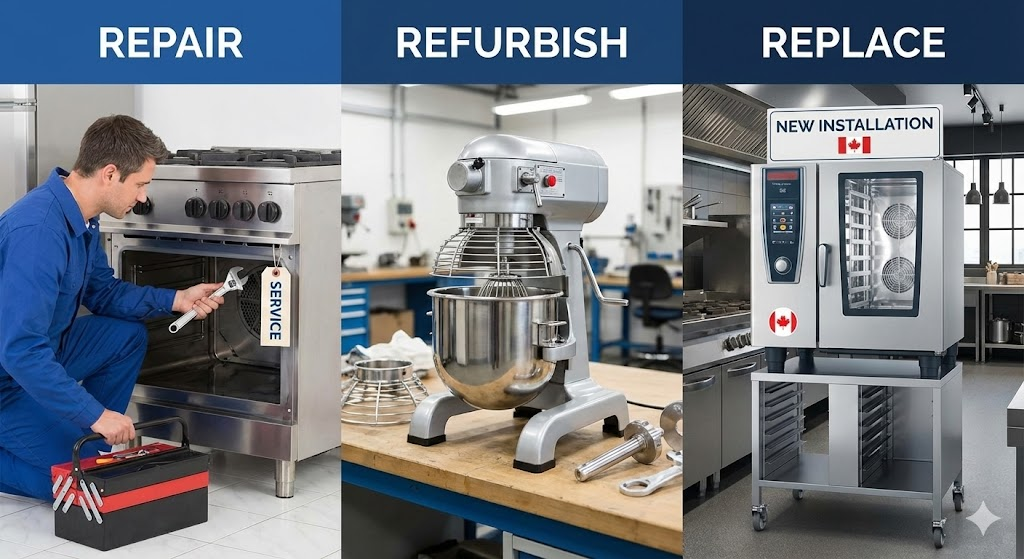

Commercial kitchen equipment is one of the most important long-term investments a restaurant can make. In Canada’s foodservice sector, where energy costs, labour shortages, and compliance pressures continue to rise, understanding when to repair, refurbish, or replace commercial kitchen equipment is essential for controlling expenses and maintaining operational uptime.
A strategic lifecycle approach allows restaurant owners, managers, and franchise operators to protect high-value assets, reduce downtime, and extend equipment performance. This guide provides a researched, practical framework to help Canadian operators make informed decisions.
Why Understanding Equipment Lifecycle Matters
A commercial kitchen’s efficiency depends on the reliability of its appliances. According to industry data from Energy Star Canada and CFIA food-safety guidance, poorly maintained or failing equipment leads to:
- Higher energy consumption
- Increased food-safety risks
- Inconsistent performance
- Higher long-term repair costs
- Productivity slowdowns during peak service
Reliable commercial kitchen equipment must deliver both performance and durability, but even the highest-quality appliances reach performance decline stages. Knowing whether to repair, refurbish, or replace ensures operators maximize ROI and avoid unnecessary capital expenses.
5 Signs Your Equipment Needs Attention
Before deciding on a path forward, operators should watch for early warning signs across major equipment categories: cooking, refrigeration, warewashing, and ventilation.
1. Inconsistent performance
Uneven cooking, slow recovery times, unstable refrigeration temperatures, or reduced airflow often indicate underlying component failures.
2. Rising repair frequency
If a unit needs service calls more than twice in a short period, the internal components may be approaching end-of-life.
3. Higher utility consumption
Older appliances lose efficiency due to worn parts, insulation breakdown, or outdated technology. In Canada—where commercial kitchens use 5× more energy per square foot than other commercial buildings—this quickly impacts operating costs.
4. Unusual noises, smells, or heat output
These often signal failing motors, electrical issues, or airflow blockages that must be addressed promptly.
5. Food-safety compliance issues
For refrigeration, any temperature-holding inconsistencies require immediate assessment. CFIA regulations make equipment reliability non-negotiable.
When to Repair: The Right Choice for Minor or Isolated Issues
Repair is typically the most cost-effective option when:
The issue is localized and inexpensive
Examples include:
- Thermostats
- Door gaskets
- Heating elements
- Sensors
- Switches
- Igniters
These repairs restore full function without major downtime.
The unit is still under warranty
Manufacturer coverage often makes repairs low- or no-cost, especially for high-use appliances such as combi ovens or high-speed cooking systems.
The equipment is relatively new
For appliances equipped with modern controls, repairs help preserve valuable technology investments.
Replacement parts are readily available
Working with established restaurant equipment suppliers in Canada, such as Celco, ensures access to genuine parts that extend service life.
There are no safety concerns
If the root issue does not involve gas leaks, electrical hazards, or structural component failure, repair is generally safe and viable.
When to Refurbish: Extending Equipment Life Cost-Effectively
Refurbishment sits between repair and replacement and can dramatically extend equipment life, especially for high-value, durable appliances.
Refurbishing is ideal when:
The unit is mechanically sound but struggling with performance
Common examples:
- Worn burners
- Damaged insulation
- Failing fans or motors
- Recalibration needs
- Surface or structural wear
These issues can be fully restored through professional refurbishment.
The equipment is in a heavy-duty category
Canadian foodservice operators often refurbish:
- Combi ovens
- Large refrigeration units
- High-speed ovens
- Stainless steel prep equipment
- Dishwashers
These appliances are engineered for long life and respond well to refurbishment.
Sustainability and waste reduction matter
Refurbishing avoids premature disposal and reduces environmental footprint, aligning with Canada’s growing sustainability expectations across foodservice operations.
Replacement cost is significantly higher
If the cost of refurbishment is 30–50% of replacement cost, it is generally more cost-effective to refurbish.
The unit is still compliant with safety and sanitation standards
Refurbishment must not compromise CFIA, electrical, or gas compliance.
Professional refurbishment is common in foodservice equipment maintenance because it restores reliability at a fraction of the replacement cost.
When to Replace: The Most Strategic Long-Term Move
Replacement becomes the best choice when performance issues compromise cost control, food safety, or the ability to meet service demand.
Operators should replace commercial kitchen equipment when:
Repair costs exceed 50% of the replacement cost
This is a standard industry benchmark across North America.
Equipment is at or beyond its expected lifespan
General lifespan averages:
- Refrigeration: 10–15 years
- Gas ranges & ovens: 12–18 years
- High-speed ovens: 6–10 years
- Dishwashers: 8–12 years
- Ventilation components: 15–20 years
Once near these thresholds, breakdowns typically accelerate.
Energy consumption is significantly higher than newer models
Energy-efficient models (ENERGY STAR certified) can reduce energy consumption by 20–35%, especially in refrigeration and cooking applications.
Safety risks appear
These include:
- Gas leaks
- Electrical shorts
- Frequent overheating
- Structural corrosion
Safety risks must never be addressed through repeated repairs.
The unit impacts service speed or product quality
Slow recovery times, unreliable temperatures, or constant reset needs affect labor efficiency and customer experience.
New technology improves ROI
Modern features—smart controls, IoT monitoring, predictive diagnostics—provide long-term savings impossible with outdated models.
In these cases, replacement is the most financially sound decision.
Cost vs. ROI: Making the Smartest Long-Term Decision
Evaluating cost vs. ROI requires factoring in more than the upfront purchase price.
Key Considerations
- Energy usage over time
- Maintenance frequency
- Downtime costs
- Staff training efficiency
- Food waste is associated with inconsistent equipment
- Warranty coverage on new models
- Availability of replacement parts
For many operators, the total cost of ownership (TCO) makes replacement more economical than ongoing repairs, especially for older refrigeration, ovens, or dishwashers.
Celco’s Role: Reliable Support Across the Equipment Lifecycle
As one of the leading restaurant equipment suppliers in Canada, Celco supports operators through every stage of the equipment lifecycle. Our team provides:
Expert Assessment
Helping determine whether repair, refurbishment, or replacement is the most cost-effective option.
Access to Genuine Parts
Supporting long-term performance for all major commercial appliances.
High-Quality Replacement Equipment
Including energy-efficient, technologically advanced models across cooking, refrigeration, and food-warming categories.
Compliance-Ready Solutions
All equipment meets Canadian safety standards and performance expectations.
Long-Term Sustainability Benefits
By assisting operators in extending equipment life where appropriate and replacing only when necessary, we support a more sustainable Canadian foodservice ecosystem.
A Strategic Framework for Better Equipment Decisions
Knowing when to repair, refurbish, or replace commercial kitchen equipment allows restaurant owners and managers to maximize performance and minimize operational risk. Small issues are often easily repairable, high-value appliances can typically be refurbished, and outdated or unsafe equipment should be replaced to maintain efficiency and safety.
With Celco as trusted partners throughout the lifecycle, operators gain access to reliable expertise, compliant solutions, and durable equipment that deliver long-term value. If you’re ready to evaluate your equipment and make informed lifecycle decisions, our team is here to help with data-driven recommendations that protect your investment and support your kitchen’s performance for years to come.