


Commercial microwaves in Canada are the mainstay of restaurants, cafes, and cafeterias across the country. But before commercial microwaves in Toronto, Montreal, and Vancouver restaurants became popular pieces of kitchen equipment, the common microwave was considered a luxury item!
When Were Microwave Ovens Invented?
The microwave oven was invented in 1945. This was during World War II, a time when radar technology was advancing rapidly. Percy Spencer’s discovery of microwave heating wasn’t a planned scientific breakthrough.
While testing a new vacuum tube called a magnetron, he discovered that a chocolate bar in his pocket had melted from the heat. He decided to try another experiment by placing some popcorn kernels near the magnetron, and he watched as the kernels popped into fluffy popcorn.
Next, Spencer placed an egg near the magnetron and the egg began to move from the heat, creating pressure inside the egg. The egg exploded and Spencer saw that the yolk had become hot. He realised that the low-density energy from the magnetron could cook food quickly.
He created a metal box with an opening through which he fed microwave power. The energy was trapped inside the box, which created a high-density magnetic field. He placed food inside the box, and the heat generated by the energy cooked the food. The first microwave oven was born.
The concept of using electromagnetic waves to heat objects wasn’t new, but Spencer was the first to observe and test how microwave energy could cook food. His discovery led to a new direction for the use of radar and magnetron technology beyond military applications.
Who Made the Microwave?
Percy Spencer, an American engineer with no formal education beyond grammar school, made the first microwave. Working at Raytheon, he was known for his hands-on approach to problem-solving and for improving magnetron production. His curiosity and quick thinking turned a radar experiment into one of the most significant kitchen appliance innovations of the 20th century.
Spencer’s methodical follow-up experiments, starting with popcorn and then progressing to an egg, were simple yet effective. After noticing how microwaves could rapidly heat organic material, he designed the first cooking device to harness that energy. He filed the first patent for a microwave cooking process in 1945, and Raytheon built a prototype shortly after.
Radarange: The Original Microwave Oven
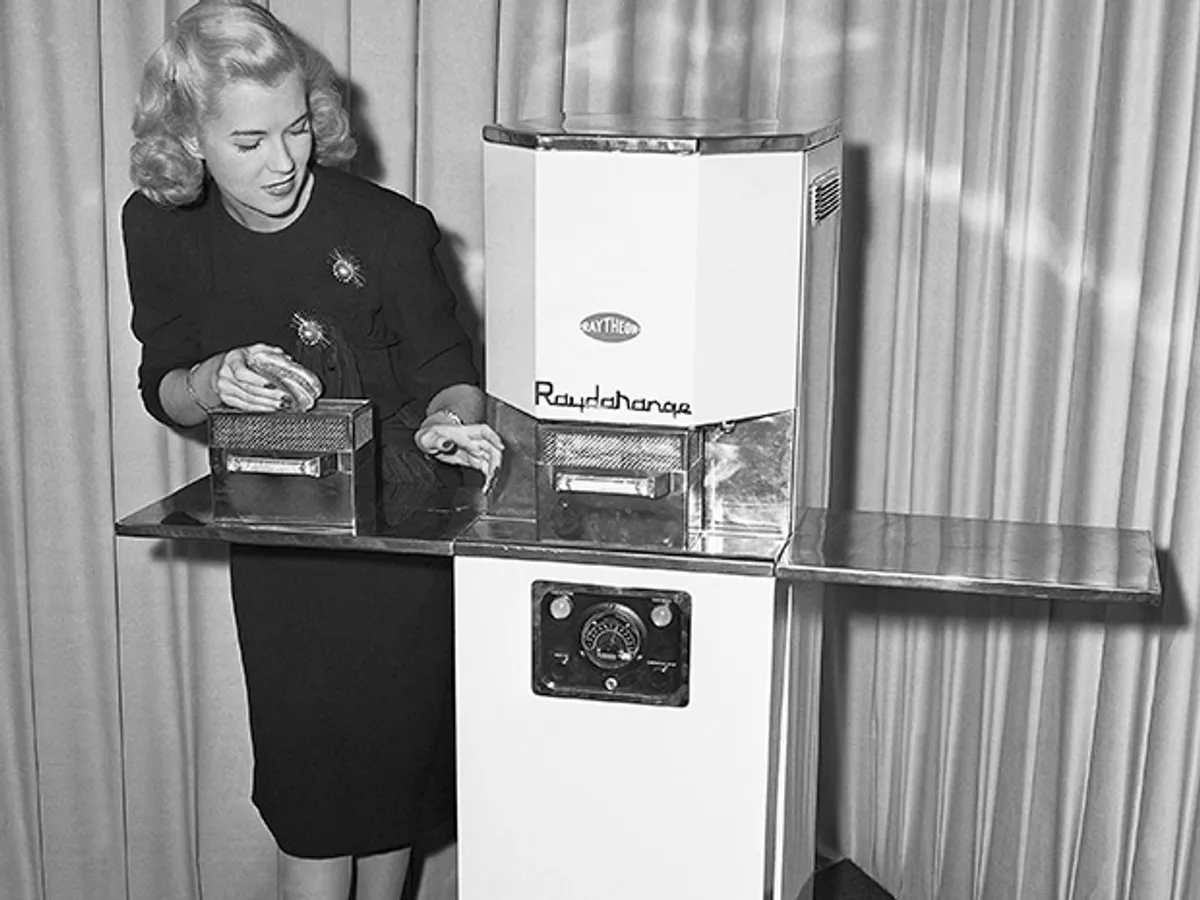
The first commercial microwave oven was called the “Radarange.” Developed by Raytheon and released in 1947, this machine stood over five feet tall and weighed around 750 pounds. It consumed enormous amounts of electricity and required water cooling.
Despite its size and price (around $5,000 at the time), it marked the beginning of microwave technology’s commercial use. These early models were primarily used in ships, hospitals, and research laboratories due to their speed and efficiency.
The Radarange was not designed for home kitchens. It was industrial-grade and designed to rapidly reheat meals or thaw frozen food in high-volume environments. Restaurants and ocean liners were among the first to test the technology. The idea of a microwave oven in the home wasn’t considered practical until major design revisions in the 1960s and 1970s.
Restaurants Embrace Microwaves
The first commercial use of a microwave oven was in 1946 in a Boston restaurant to test its effectiveness. In 1947, commercial microwave ovens became available for purchase. Early microwaves were like giants compared to modern compact microwaves, as they were 5.5 feet tall and weighed over 750 pounds. They also carried a hefty $5,000 price tag. The high price, large size, and consumer suspicion about the new technology suppressed microwave sales.
The microwave was initially considered a luxury item and only used in expensive eateries that could afford one. However, design improvement soon made the microwave lighter and less costly, which made it more appealing to restaurant owners. Microwaves soon gained a popular following in restaurants and vending companies, as the machines allowed these companies to quickly heat up food as it was ordered. The result was less food waste, fresher food, and money saved. The food industry soon found innovative uses for the microwave, such as drying potato chips, roasting coffee beans, and peanuts. It became a necessity for many industries, and its possible uses seemed endless.
When Did the Microwave Become Popular?
Microwaves gained widespread popularity in the 1970s. As manufacturers refined their designs, reducing size, weight, and cost, households and businesses began adopting them.
In 1975, microwave oven sales in the United States surpassed those of gas ranges for the first time. Their popularity grew quickly in Canada as well, particularly in urban areas such as Toronto, Montreal, and Vancouver, where the demand for faster meal preparation suited busy lifestyles.
During this time, consumer perception shifted. Early concerns about radiation and food quality were replaced by convenience and time savings. Manufacturers added safety features, timers, and preset functions, making microwaves more appealing for everyday cooking.
By the late 1980s, having a microwave oven at home was no longer considered a luxury; it had become a standard.
Microwaves Become a Household Staple
By 1975, consumer demand for microwave ovens had greatly increased and they sold more units than gas ranges. Consumers were busier and their cooking habits had changed, and the quick and easy cooking supplied by the microwave oven made it a household staple. Now, microwave ovens are available with a variety of new features, such as convection heating, probe and sensor cooking, and pre-programmed timers to ensure perfect cooking. Microwaves are an important addition to every commercial kitchen to provide fast and efficient cooking.
Find Celcook Commercial Microwaves in Canada
Looking for powerful commercial microwaves in Toronto, Montreal, and Vancouver to enhance your commercial kitchen? Celcook’s high-quality commercial microwave ovens were launched by Celco, Canada’s leading distributor of commercial kitchen equipment. You can find Celcook products in reputable commercial kitchens across Canada, including in the healthcare market, many fast-food chains, fine dining restaurants, convenience stores, hotels, pubs, golf courses, schools, and government institutions.
Explore our microwave oven range and contact the experts at Celco to get a Celcook product for your kitchen.